


Commercial garage doors are working assets built to handle far heavier daily use than any residential door, and choosing the right one directly affects your building’s security, workflow, and operating costs. Whether you run a warehouse, auto shop, storage facility, or loading dock, the door type you select determines how well your operation moves goods, controls climate, and holds up over years of frequent cycling. This guide compares four main commercial door types, explains what drives their durability, and lays out realistic 2026 pricing so you can budget with confidence.
Here is what you will learn in this guide:
- The four types: Sectional steel, rolling steel, high-speed, and full-view doors and where each fits.
- Durability factors: What cycle ratings, materials, and construction mean for a door’s lifespan.
- 2026 pricing: Realistic installed-cost ranges for each door type and the factors that move them.
Understanding Commercial Garage Doors
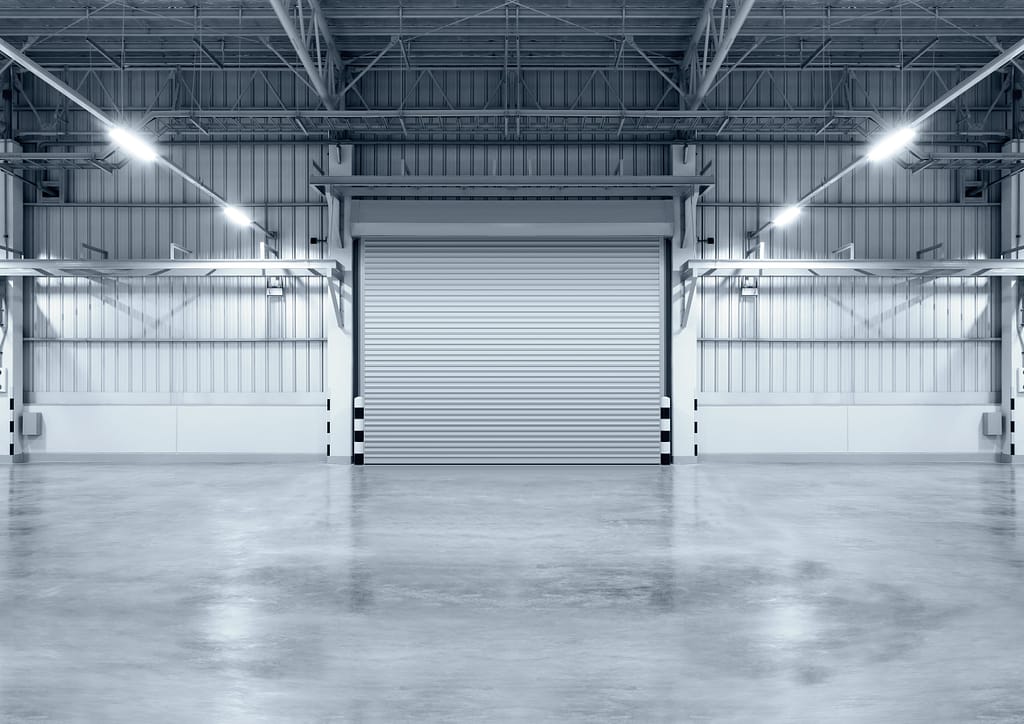
Commercial garage doors differ from residential models in scale, construction, and how hard they are engineered to work. Understanding what sets them apart helps a business owner match the right door to the demands of the building and daily operations.
How Commercial Doors Differ From Residential
Commercial doors are larger, more durable, and engineered for high-frequency use, often opening dozens or even hundreds of times per day. Where a home door lifts a few times daily, a commercial door in a busy facility cycles constantly, which demands reinforced steel components, heavy-duty tracks and rollers, and commercial-grade springs built for that workload. Commercial openings are also far wider and taller than residential ones, requiring stronger hardware and more material to span a loading dock or warehouse bay. These engineering differences are why commercial doors cost more and last longer under heavy use than a residential door ever could.
- Higher use: Commercial doors may cycle dozens or hundreds of times daily.
- Reinforced build: Heavy-duty tracks, rollers, and springs handle the workload.
- Larger openings: Wider, taller doors need stronger hardware and more material.
- Built to last: Commercial construction endures use that would wear out a home door.
Why Choosing the Right Door Type Matters
The right commercial door improves security, workflow, and energy efficiency, while the wrong one creates bottlenecks and ongoing costs. A door’s speed affects how quickly vehicles and goods move through an opening, its insulation affects heating and cooling bills in a conditioned space, and its durability affects how often you face downtime and repairs. Matching the door to your traffic level, security needs, and climate control requirements is the single most important decision for your building. A door chosen on price alone often costs more over its life through energy loss, repairs, and lost productivity.
- Workflow impact: Door speed determines how fast traffic moves through the opening.
- Energy efficiency: Insulation controls heating and cooling costs in conditioned space.
- Downtime risk: Durability affects repair frequency and operational interruptions.
- Total cost: The cheapest door often costs more over its full lifespan.
4 Types of Commercial Garage Doors
The four commercial door types below cover the vast majority of business applications, each with distinct strengths in cost, speed, space, and durability. Understanding what each one does best makes it far easier to match a door to your facility.
1. Sectional Steel Doors
Sectional steel doors are the most common commercial type, built from horizontal panels connected by hinges that roll up along overhead tracks. They strike a strong balance of durability, insulation options, and cost, which makes them a versatile fit for warehouses, service centers, and general commercial buildings. Because insulation can be added between the steel panels without major design changes, sectional doors suit climate-controlled spaces well. Their panel-and-track system is well understood, widely available, and typically lasts 20 to 25 years with proper maintenance.
- Construction: Horizontal steel panels on an overhead track system.
- Best for: Warehouses, auto shops, and general commercial buildings.
- Key strength: Easy insulation options and a strong cost-to-performance balance.
- Typical lifespan: Roughly 20 to 25 years with regular maintenance.
2. Rolling Steel Doors
Rolling steel doors use interlocking steel slats that coil into a compact drum above the opening, making them ideal where overhead and side space is limited. Their simple, rugged design means fewer wear points and exceptional security, which is why they are the standard for storage facilities, loading docks, and manufacturing plants. This simplicity also gives them a longer service life than sectional doors, commonly 20 to 30 years when properly maintained. Specialized fire-rated rolling steel doors are also required by code in certain locations to compartmentalize a building during a fire.
- Construction: Interlocking steel slats that coil into a compact overhead drum.
- Best for: Storage facilities, loading docks, and tight-clearance openings.
- Key strength: Maximum security, few wear points, and space savings.
- Typical lifespan: Roughly 20 to 30 years with proper maintenance.
3. High-Speed Doors
High-speed doors open and close far faster than traditional doors, with some systems moving as fast as 8 feet per second to keep openings closed as much as possible. This rapid operation is built for facilities with constant traffic or strict climate control, since minimizing open time cuts energy loss, dust infiltration, and security exposure. High-speed doors come in flexible fabric and rigid insulated versions, with fabric models costing more but delivering major energy and workflow savings in the right setting. They shine in food processing, cold storage, and high-volume distribution where every second of open time adds up.
- Construction: Fabric or rigid panels engineered for rapid, frequent cycling.
- Best for: High-traffic openings and strict climate-control environments.
- Key strength: Fast operation that cuts energy loss and dust infiltration.
- Ideal settings: Food processing, cold storage, and busy distribution centers.
4. Full-View Aluminum and Glass Doors
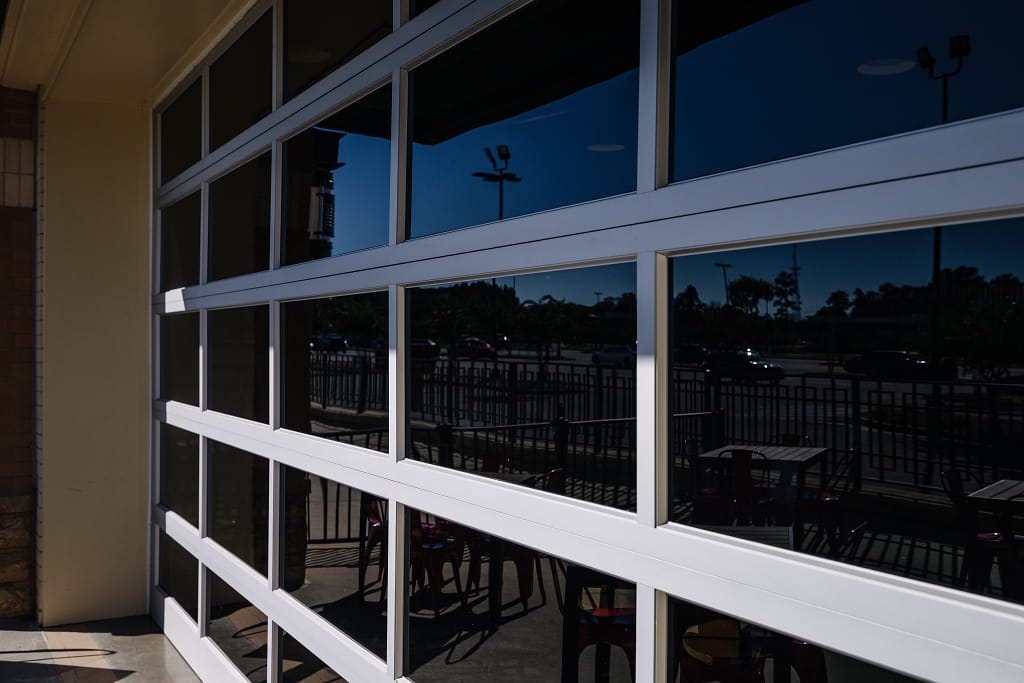
Full-view doors use an aluminum frame holding glass or polycarbonate panels, combining natural light with a clean, modern appearance. They are a fast-growing choice for showrooms, dealerships, restaurants, and retail spaces where visibility and aesthetics matter as much as function. Available with insulated dual-pane glass, they can balance the open, architectural look with reasonable thermal performance for conditioned spaces. While they are less about heavy industrial duty and more about presentation, full-view doors operate as standard sectional doors and suit customer-facing commercial settings.
- Construction: An aluminum frame holding glass or polycarbonate panels.
- Best for: Showrooms, dealerships, restaurants, and retail storefronts.
- Key strength: Natural light and a modern, customer-facing appearance.
- The option: Insulated dual-pane glass improves thermal performance.
According to the ANSI/DASMA 102 standard published by the Door and Access Systems Manufacturers Association, a commercial sectional door is defined as one normally expected to be operated at fewer than 5,000 cycles per year, compared with fewer than 1,500 cycles per year for a residential door (Source: Door and Access Systems Manufacturers Association – DASMA Standards). That roughly threefold difference in expected use is exactly why commercial doors are engineered with heavier components and higher cycle-rated springs, and why matching the door’s cycle rating to your actual daily traffic is critical to its lifespan.
Commercial Garage Door Durability
Durability is where commercial doors earn their higher price, since a door that fails mid-shift can halt an entire operation. The factors below determine how long a commercial door will hold up under your specific workload.
What Cycle Ratings Mean for Lifespan
A cycle rating is the number of open-and-close cycles a door and its springs are engineered to handle before wearing out, and it is the most important durability spec for a commercial door. Standard springs may be rated for around 10,000 cycles, while high-cycle commercial springs can be rated for 50,000, 100,000, or more, dramatically extending service life in a high-traffic setting. A door that cycles 50 times a day burns through a standard rating in a couple of years, so matching the cycle rating to real usage prevents premature failure. Choosing the correct rating up front is far cheaper than repeated spring replacements and unplanned downtime.
- The definition: Cycle rating is how many open-close cycles the door is built for.
- The range: Standard springs run about 10,000 cycles; high-cycle options reach 50,000-plus.
- The math: Heavy daily use exhausts a low rating in just a few years.
- The payoff: Matching rating to traffic avoids premature failure and downtime.
How Materials and Maintenance Affect Durability
Beyond cycle ratings, the door’s material and a consistent maintenance routine determine how many years it actually delivers. Heavy-gauge steel resists dents and corrosion far better than lighter material, and insulated doors with tight weather seals hold up better against temperature swings and air leakage. Even the toughest commercial door strains under constant use, so regular professional inspections catch worn rollers, cables, and springs before they cause a breakdown. Preventive maintenance is the difference between a door that reaches the top of its lifespan range and one that fails early.
- Material grade: Heavy-gauge steel resists dents and corrosion better than light stock.
- Weather sealing: Insulated doors with tight seals endure temperature swings well.
- Regular inspection: Professional checks catch worn parts before they fail.
- The result: Maintenance determines whether a door reaches its full lifespan.
2026 Commercial Garage Door Pricing
Commercial door pricing in 2026 varies widely based on type, size, insulation, and automation, so the ranges below are installed estimates to help you budget. A precise quote always requires an on-site assessment of your opening and building.
Price Ranges by Door Type
In 2026, most commercial garage doors cost between $1,500 and $7,000 installed, though larger, insulated, or specialty doors run considerably higher. Roll-up and sectional steel doors typically sit in the lower and middle of that range, insulated and heavy-duty doors run roughly $4,000 to $10,000, and high-speed or oversized doors can reach $20,000 or more. A commercial door opener usually adds about $600 to $1,500 on top of the door itself. Full-view aluminum and glass doors generally fall between $4,000 and $12,000 depending on size and glazing.
- Sectional and roll-up steel: Roughly $1,500 to $7,000 installed for standard sizes.
- Insulated and heavy-duty: Approximately $4,000 to $10,000 depending on specs.
- High-speed doors: Often $5,000 to $20,000 or more based on automation.
- Openers: A commercial operator typically adds $600 to $1,500.
Factors That Affect Your Final Price
Several variables determine where your door falls within these ranges, so understanding them helps you plan an accurate budget. Door size is the biggest driver, since a large warehouse or dock opening needs more material, heavier tracks, and stronger springs than a small service bay. Cycle rating, insulation level, and automation each add cost, as does any structural modification needed to fit the door. Access control, dock integration, and smart features push the total higher, which is why an itemized quote matters.
- Door size: Larger openings require more material and heavier hardware.
- Cycle and insulation: Higher cycle ratings and insulation add cost.
- Automation: Openers, access control, and smart features increase the total.
- Site work: Structural modifications to the opening affect labor cost.
Frequently Asked Questions

How much does a commercial garage door cost in 2026?
Most commercial garage doors cost between $1,500 and $7,000 installed in 2026, with insulated and heavy-duty doors running roughly $4,000 to $10,000. High-speed and oversized custom doors can reach $20,000 or more. A commercial opener typically adds $600 to $1,500 on top of the door.
Which commercial garage door type is most durable?
Rolling steel doors are among the most durable, commonly lasting 20 to 30 years thanks to their simple, rugged design with few wear points. Sectional steel doors typically last 20 to 25 years. Durability depends heavily on the door’s cycle rating and consistent maintenance.
What is a cycle rating on a commercial door?
A cycle rating is the number of open-and-close cycles a door and its springs are built to handle before wearing out. Standard springs are often rated near 10,000 cycles, while high-cycle commercial options reach 50,000 or more. Matching the rating to your daily traffic is key to a long lifespan.
How often do commercial garage doors need maintenance?
Businesses should perform basic visual checks monthly and schedule a full professional inspection at least once a year. High-traffic doors that cycle hundreds of times daily may need service more often. Regular maintenance catches worn springs, cables, and rollers before they cause downtime.
Are insulated commercial doors worth the cost?
Insulated commercial doors typically cost 30 to 50 percent more than non-insulated versions, but they pay back through energy savings in heated or cooled buildings. They also reduce air leakage and dampen noise. For any climate-controlled facility, insulation is usually a smart investment.
What is the difference between a rolling steel and a sectional door?
Rolling steel doors coil into a compact drum overhead and suit tight spaces with maximum security, while sectional doors use hinged panels on a track and offer easier insulation. Rolling doors generally last longer, while sectional doors often cost less upfront. The best choice depends on your space and use.
Why Choose Apple Door Systems for Your Commercial Garage Doors
Apple Door Systems has served Virginia businesses since 1973, and that half-century of experience makes us the partner to trust for your commercial door needs. As a premium dealer for leading manufacturers, we supply and install the full range of commercial doors, from sectional and rolling steel to high-speed and full-view systems, and we match the cycle rating, insulation, and automation to how your facility actually operates. We back every installation with warranties, offer financing, and provide emergency repair service to keep your operation moving when a door goes down. If you are planning a new commercial garage door or replacing an aging one, reach out to Apple Door Systems today for a free quote tailored to your building, traffic, and budget.
